

In the high-end secondhand market, a saying circulates widely: “You are not just buying a product. You are buying an authenticator’s eye.”
Professional authentication is no longer optional for cross-border transactions. Thousands of kilometers separate buyers and sellers. Regional grading standards also vary. Therefore, authentication is the logic supporting the entire transaction.
The Devil in the Details
Top-tier luxury goods derive value from microscopic details. These are often invisible to the naked eye.
Consider wristwatches. Genuine movements feature specific chamfered polishing. Screws show a unique quenched blue-steel hue. Shock absorbers have delicate structures. These craft barriers are hard for counterfeiters to replicate.
At FishGo’s lab, our experts do more than verify authenticity. They read the fingerprints left by brand history.
The Trust Divide in Cross-Border Transactions
“Goods not matching the description” is a major headache for cross-border buyers. Physical distance prevents personal inspection.
A detailed, legally valid authentication report acts as a “digital physical object.” It records every tiny scratch. It notes the oxidation level of each metal component. It captures the real grain of the leather.
Professional authentication eliminates counterfeit risks. It also unifies cross-border grading definitions. Subtle differences between Grade S and Grade A become clear. Trust remains intact despite the distance.
The FishGo Standard: From Rejection to Delivery
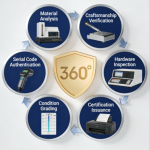
At FishGo, authentication begins with full-coverage macro documentation.
We use high-power electron microscopes. These capture craft flaws that even high-level Super Clones cannot avoid.
Items must pass multiple tests to earn our “Trust Label.” We conduct physical, optical, and chemical composition analyses. This is essential for precious metals.
We know a hard truth: building trust takes a thousand efforts. Yet, one shoddy detail can destroy it all.